

Clinical Notes
Why Does Filler Still Hurt After Numbing Cream? — A Guide to Nerve Block Anesthesia
An explanation of why topical numbing may not fully address filler discomfort, and how clinicians consider local anesthesia and nerve blocks.

What do numbing cream and nerve blocks each do in filler treatment? We explain how the two differ, where each is used, how pain is managed, and how sensation may change afterward.
Why Does Filler Still Hurt After Numbing Cream? — A Guide to Nerve Block Anesthesia
Oct 31, 2026 · WayB Clinic
Hello, I’m Dr. Jisu Lee from WayB Clinic.
“Is it okay that no numbing cream was applied?” “Why does it hurt so much even with numbing cream?” If you have had filler or collagen booster treatment, you may have asked one of these questions yourself.
The key point is that pain during filler treatment is not a matter of pain tolerance, but of which depth has been anesthetized.
Numbing cream, or topical anesthesia, numbs only the skin’s surface. Filler needles, however, pass through the dermis—the deeper tissue layer of the skin—and into the underlying fat layer or down to the tissue above the bone. Pain at a depth the cream cannot reach is therefore to be expected.
To reduce pain at that depth, a nerve block is needed to block the nerve trunk responsible for sensation in the area.
The positions of the bony openings through which nerves emerge vary with the shape of the facial bones. East Asian faces are relatively flat, with cheekbones that project forward and laterally and a brachycephalic, or short-headed, skull shape. As a result, landmarks may feel different on palpation from what would be expected using anatomical diagrams based on Western populations. This is why palpation suited to Korean facial anatomy is necessary.
Facial Sensation Is Divided Among Three Branches of the Trigeminal Nerve
Sensation in the facial skin is supplied by the trigeminal nerve, the fifth cranial nerve, which divides into three branches, as its name suggests. The treatment area determines which nerve needs to be blocked.
- Branch — V1
- Name — Ophthalmic nerve
- Area Supplied — Forehead, glabella, upper eyelid, nasal bridge
- Branch — V2
- Name — Maxillary nerve
- Area Supplied — Lower eyelid, side of the nose, upper lip
- Branch — V3
- Name — Mandibular nerve
- Area Supplied — Cheek, lower lip, chin
One point is particularly important clinically: nerves do not simply run as a few thick lines. The textbook explains that the distribution of each facial nerve is better understood as an area rather than a line. In reality, the branches form an interwoven network and overlap with adjacent nerve territories.
This explains why a single nerve block does not always completely anesthetize the entire area. Knowing this in advance can help you understand why you may still feel sensation in a particular spot during treatment.
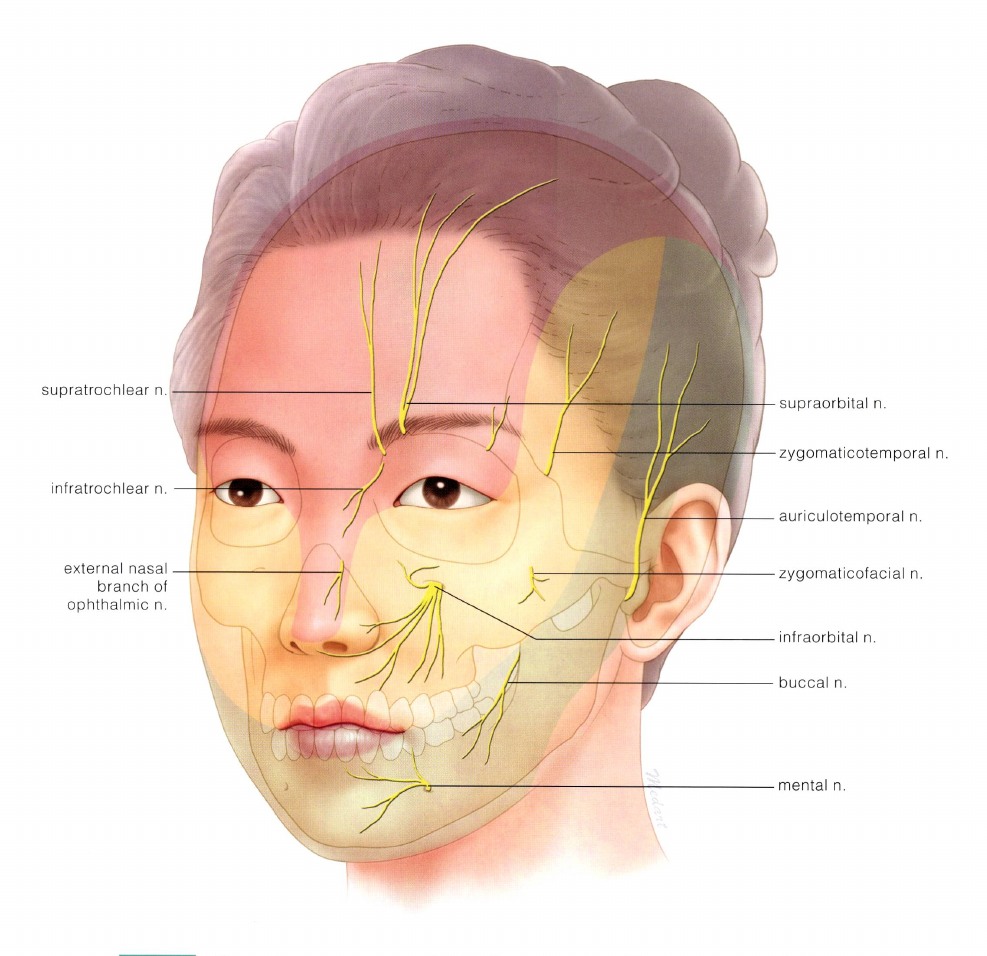
▲ Map of cutaneous sensory distribution in the face. Red indicates V1 (ophthalmic nerve), yellow V2 (maxillary nerve), and green V3 (mandibular nerve). The supraorbital, supratrochlear, infraorbital, and mental nerves are shown emerging from bony openings and spreading into a network. (Source: Clinical Anatomy for Botulinum Toxin and Filler Injections, p. 34)
Three Anesthesia Methods for Filler — Comparing Topical Anesthesia, Lidocaine, and Nerve Blocks
There are three main approaches to anesthesia for filler treatment, and they complement rather than replace one another. At WayB Clinic, we combine them as appropriate for each area. Although pain is not eliminated entirely, these methods can make filler treatment relatively comfortable.
- Anesthesia Method — Topical anesthesia (numbing cream)
- Depth / Extent of Action — Epidermis to superficial dermis
- Advantages — Simple; no swelling
- Limitations — Insufficient for pain from deeper injections
- Anesthesia Method — Lidocaine mixing / infiltration
- Depth / Extent of Action — Local to the injection site
- Advantages — Reduces the pain of filler injection itself
- Limitations — Initial needle pain remains
- Anesthesia Method — Nerve block anesthesia
- Depth / Extent of Action — Entire nerve territory
- Advantages — Broadest scope of pain control
- Limitations — Possible swelling, bruising, and distortion of landmarks
1. Topical Anesthesia
This means numbing cream. It acts only on the epidermis and superficial dermis. Applied 20–30 minutes before treatment, it is useful for superficial procedures and for reducing the needle pain of the nerve block injection itself.
2. Lidocaine Mixing / Infiltration
We either use a filler product that already contains lidocaine or inject a small amount of anesthetic directly into the treatment site. This reduces pain during injection, but the pain of the initial needle insertion remains.
3. Nerve Block Anesthesia
Anesthetic is placed at the point where a nerve emerges from a bony opening, numbing the entire territory supplied by that nerve at once. The following blocks are commonly used in aesthetic procedures.
- Supraorbital nerve block (SON block) / supratrochlear nerve block (STN block) — forehead and glabella
- Infraorbital nerve block (ION block) — nose, lower eyelid, upper lip, and nasolabial area
- Mental nerve block (MN block) — lower lip and chin
- Auriculotemporal nerve (ATN), great auricular nerve (GAN), and zygomaticotemporal nerve (ZTN) blocks — temples and the area around the ears
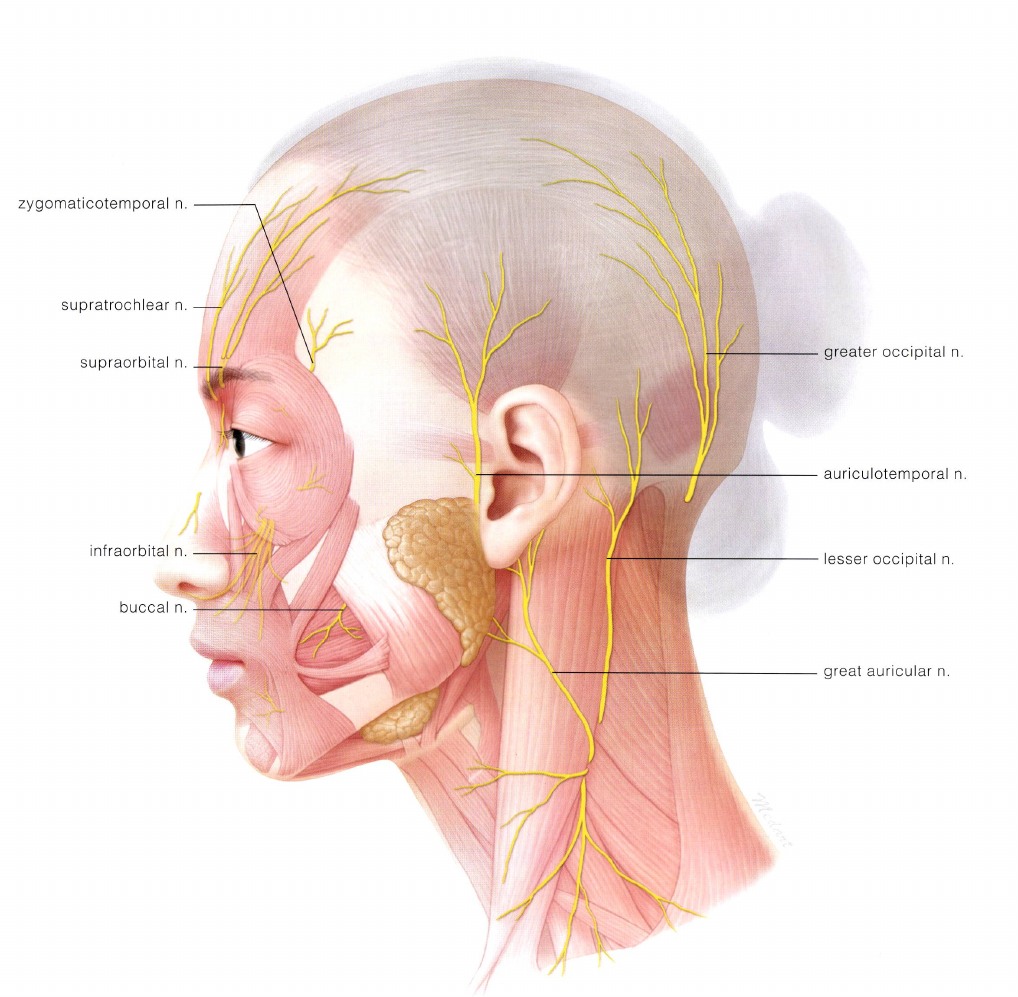
▲ Distribution of cutaneous sensory nerve branches in the head and neck, viewed from the side. Each block targets the point where these nerves emerge toward the surface. The auriculotemporal nerve and great auricular nerve serve as references for procedures around the temples and ears. (Source: Clinical Anatomy for Botulinum Toxin and Filler Injections, p. 46)
Nerve Blocks and Landmarks by Treatment Area
Each treatment area—the forehead, nose, lips, chin, and so on—has a corresponding nerve and block site at a bony opening. The table below provides a reference for nerve blocks by area.
- Treatment Area — Forehead / glabella
- Nerve — Supraorbital and supratrochlear nerves
- Block — SON / STN block
- Landmark — Supraorbital notch
- Treatment Area — Nasal bridge / nasal root
- Nerve — Infratrochlear nerve and external nasal branch
- Block — INT / ENN block
- Landmark — Below the trochlea; junction of nasal bone and cartilage
- Treatment Area — Side of nose / upper lip / nasolabial area
- Nerve — Infraorbital nerve
- Block — ION block
- Landmark — Infraorbital foramen
- Treatment Area — Lower lip / chin
- Nerve — Mental nerve
- Block — MN block
- Landmark — Mental foramen
- Treatment Area — Temples / around the ears
- Nerve — Auriculotemporal and great auricular nerves
- Block — ATN / GAN block
- Landmark — Anterior to the tragus; midpoint of the sternocleidomastoid muscle
The three main openings lie almost along a single vertical line. The supraorbital notch, infraorbital foramen, and mental foramen lie approximately 2.5 cm lateral to the facial midline and are commonly described as roughly aligning with the mid-pupil line.
However, the measurements differ slightly between textbooks. Some describe the supraorbital notch as 15 mm from the midline, while others give 25–27 mm. We therefore do not choose an injection site simply by memorizing numbers: we always locate the notch directly with the fingertips before determining the position. Palpation is especially important in East Asian faces with prominent cheekbones.
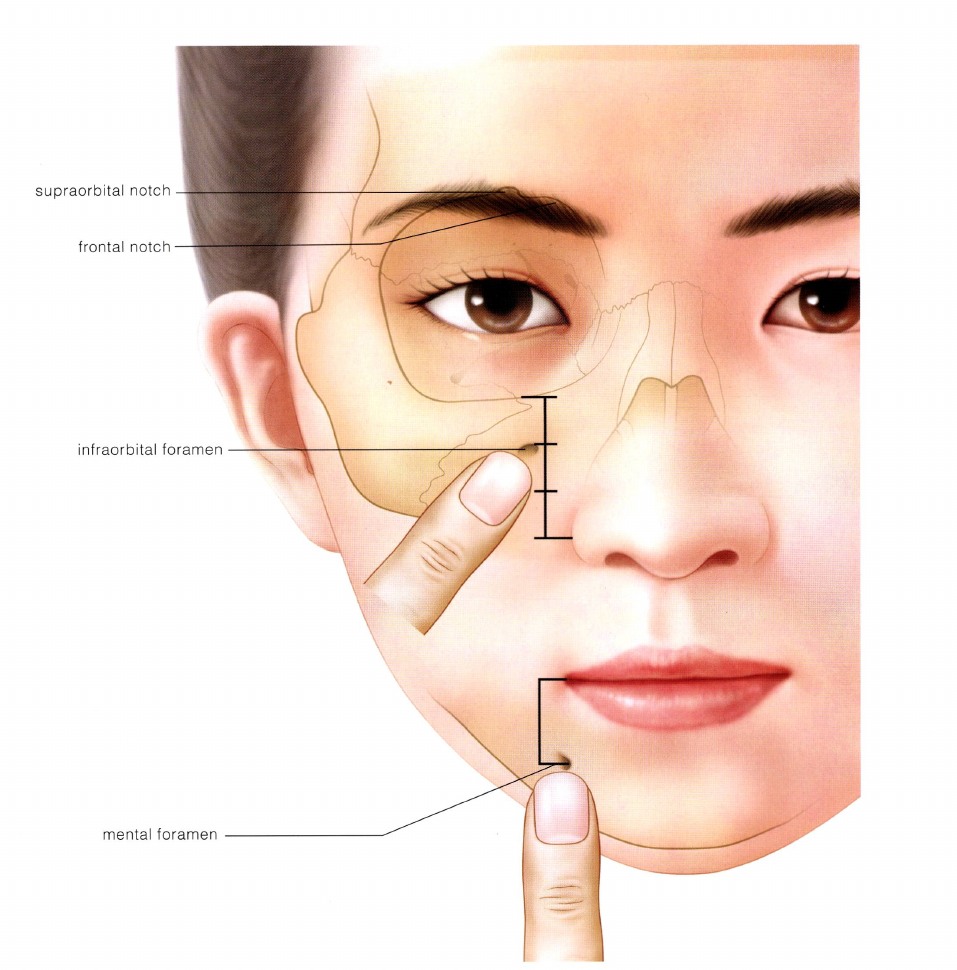
▲ Palpation of the supraorbital notch, infraorbital foramen, and mental foramen with the fingers. The three openings can be seen lying almost along one vertical line. (Source: Clinical Anatomy for Botulinum Toxin and Filler Injections, p. 65)
How Nerve Block Sites Are Located in Clinical Practice
Textbook measurements are only a starting point; the actual block site is determined through palpation and consideration of individual anatomical variation. Here are the practical reference points for three commonly used blocks.
Infraorbital Nerve Block (ION Block) — Side of the Nose, Upper Lip, and Nasolabial Area
- The infraorbital foramen lies on the mid-pupil line, 5–7 mm below the inferior orbital rim, and opens inferomedially.
- Pushing the needle directly into the foramen can cause nerve injury and persistent altered sensation, so the principle is to place the anesthetic near the opening.
- Care is needed because anesthetic entering the orbit can cause temporary diplopia, or double vision.
Mental Nerve Block (MN Block) — Lower Lip and Chin
- The mental foramen lies approximately 2 cm vertically below the corner of the mouth.
- Its position varies considerably. Anteroposterior variation of 6–10 mm relative to the mandibular second premolar has been reported.
- When only the lower lip needs to be anesthetized, a miniblock can be used: a small amount is placed beside the canine tooth rather than anesthetizing the entire territory.
Supraorbital / Supratrochlear Nerve Block (SON / STN Block) — Forehead and Glabella
- The supraorbital and supratrochlear nerves emerge together through the same notch in approximately 30% of cases.
- In the remaining 70%, they emerge separately, so an additional injection is needed 5–10 mm medially.
- Giving one injection and simply concluding that it has not worked can leave the patient experiencing pain partway through treatment. It is better to plan for two sites from the outset.
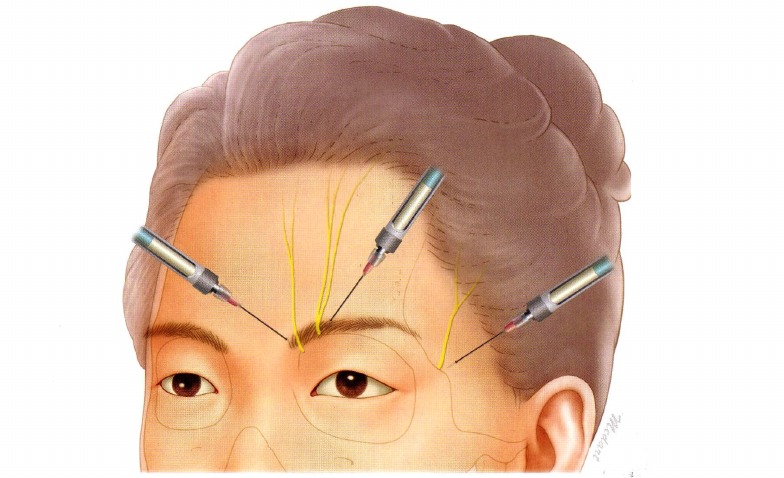
▲ Supraorbital and supratrochlear nerve blocks, with separate approaches to the medial and lateral branches. Because the two nerves emerge separately in approximately 70% of cases, at least two sites are planned from the outset. (Source: Clinical Anatomy for Botulinum Toxin and Filler Injections, p. 41)
When to Choose a Nerve Block — And When Not To
Nerve blocks are considered first for particularly painful areas or when larger volumes will be injected, but are avoided when precise volume adjustment is required. The following are the criteria I use at WayB Clinic.
- Situation — Particularly painful areas (nose, lips, chin, deep nasolabial area) or larger injection volumes
- Choice — Consider a nerve block first
- Reason — Controls deep-layer pain across the area at once
- Situation — Areas requiring fine volume adjustment
- Choice — Topical anesthesia + a lidocaine-containing product
- Reason — Swelling and bruising obscure landmarks and interfere with assessment
- Situation — Procedures requiring the patient to make facial expressions
- Choice — Minimize nerve blocks
- Reason — Only sensation is blocked and motor function remains, but the swelling itself interferes with assessment
The choice of anesthesia is not simply about finding the least painful method. It is about adequately reducing pain without compromising the accuracy of the result in that area. Tell us which area you would like treated and what result you want during the consultation, and we will plan the anesthesia together.
Four Misconceptions About Anesthesia for Filler
From the belief that leaving numbing cream on longer makes it as effective as a nerve block to the idea that a nerve block is always better, here are some common misconceptions clarified.
- Misconception — Leaving numbing cream on longer makes treatment as painless as a nerve block
- Reality — Topical anesthesia acts only on the epidermis and superficial dermis. Pain from deeper injections remains.
- Misconception — No additional anesthesia is needed if the filler contains lidocaine
- Reality — It helps with pain during injection, but initial needle pain remains. In addition, most filler instructions prohibit mixing with other substances, and only a limited number of products have officially approved lidocaine-mixing protocols.
- Misconception — A nerve block is always a good choice
- Reality — Swelling and bruising can obscure anatomical landmarks and interfere with procedures requiring precise volume adjustment.
- Misconception — Any facial nerve can be blocked anywhere
- Reality — Blocking the entire V1 division also anesthetizes the eye and can lead to corneal ulceration, so it is not performed for aesthetic procedures. A failure rate of 15–20% has been reported for inferior alveolar nerve blocks.
The pain-reducing effect of filler mixed with lidocaine is supported by clinical data. In one split-face study, immediate post-treatment pain scores on a visual analog scale (VAS) were reported as 2.8 with lidocaine and 6.6 without it. However, the added lidocaine solution can make the initial volume appear greater than the actual filler volume, which should be taken into account.
Frequently Asked Questions (FAQ)
Why does filler still hurt after numbing cream?
Numbing cream anesthetizes only the epidermis and superficial dermis. Filler needles reach deeper into the fat layer or down to the tissue above the bone, so pain is felt at depths the cream cannot reach. To reduce pain in deeper layers, a nerve block or lidocaine infiltration anesthesia needs to be used as well.
What is nerve block anesthesia?
It is a method of injecting anesthetic at the point where a sensory nerve emerges from a bony opening, numbing the entire facial territory supplied by that nerve at once. The supraorbital nerve (SON) is blocked for the forehead and glabella, the infraorbital nerve (ION) for the side of the nose and upper lip, and the mental nerve (MN) for the lower lip and chin.
What anesthesia is used for lip filler?
An infraorbital nerve block for the upper lip and a mental nerve block for the lower lip are the basic approaches. When treating only the lower lip, a miniblock using a small amount beside the canine tooth may be used to reduce swelling. Because the lips are particularly sensitive to pain, a nerve block is considered first.
If the filler contains lidocaine, is additional anesthesia unnecessary?
No. Lidocaine-containing filler reduces pain during injection (VAS scores of 2.8 versus 6.6 in a split-face study), but the pain of the initial needle insertion remains. This is why it is used together with numbing cream or a nerve block.
Can nerve block anesthesia cause side effects?
Swelling and bruising can occur at the injection site. During an infraorbital nerve block, temporary double vision can occur if anesthetic enters the orbit. Inserting the needle directly into the foramen can cause persistent altered sensation, so the principle is to place the anesthetic near the opening. When performed safely, recovery generally occurs within a few hours.
Is a nerve block always the best option?
No. Swelling and bruising can obscure anatomical landmarks and interfere with assessment in areas requiring fine volume adjustments. Nerve blocks are considered first for painful areas or larger injection volumes; for procedures requiring precision, topical anesthesia and lidocaine-containing products are used instead.
How long should numbing cream be left on?
It is usually applied 20–30 minutes before treatment. Leaving it on longer does not increase its depth of action, so other anesthesia must be used alongside it for deeper treatments.
Summary
- Pain during filler treatment is a matter of anesthetic depth, not pain tolerance. Numbing cream covers only the superficial layers.
- Each area is supplied by specific nerves, which are blocked near the bony openings where they emerge. These openings should be located by palpation.
- A nerve block is not always the best answer. Swelling can interfere with procedures that require precise volume adjustment.
If you are worried about pain during filler treatment, tell us about the area you want treated and your concerns during the consultation. WayB Clinic combines topical anesthesia, lidocaine, and nerve blocks to create an anesthesia plan suited to the treatment area and intended result.
References
- Kim Hee-jin, Seo Koo-il, Lee Hong-ki, Kim Ji-su. Clinical Anatomy for Botulinum Toxin and Filler Injections. Hanmi Medical Publishing, 2015. Chapter 1, Facial Anatomy — Section 5, Facial Nerves and Their Distribution (pp. 34–40); Section 6, Nerve Blocks (pp. 41–46); Section 8, Facial and Cranial Landmarks (p. 65); Section 9, Characteristics of the East Asian (Korean) Skull and Face (p. 69 onward).
- The Fundamentals of Botox and Fillers, 2nd Edition — Filler Volume. Chapter 17, Anesthesia for Filler Treatment (1): Nerve Block Anesthesia (pp. 169–197); Chapter 18, Anesthesia for Filler Treatment (2): Anesthetic Mixing and Injection (pp. 199–202).
- Zide BM, Swift R. How to block and tackle the face. Plast Reconstr Surg. 1998;101(3):840-851. (Multiple nerve blocks through a single needle entry and the transcutaneous nasolabial approach)
- Merz/BioForm Medical. RADIESSE Injectable Implant with lidocaine — split-face FDA study. (Cited in Chapter 18 of the textbook above)
Author

Jisu Lee, MD
Medical Director
Education
Graduated from Chungbuk National University College of Medicine
Experience
Former Training Director, Daybeau Clinic Gangnam Premium
Former Medical Director, Xenia Clinic
Former Medical Director, Daybeau Clinic Gangnam Premium
Former Medical Director, velyB Clinic Hongdae
Former Training Director, Muse Clinic Gwangmyeong
Former Medical Director, Muse Clinic Gwangmyeong
Former Intern, Asan Medical Center
Professional activities
Steering Committee Member, ARAM Practical Aesthetic Medicine Study Group
Invited Lecturer in Fillers, MediBible
Full Member, Korean Society for the Study of Obesity and Aesthetic Treatment
Full Member, Korean Aesthetic Surgery and Laser Society
Key Opinion Leader (KOL), STYLAGE® dermal fillers
Certifications
HSK Level 5 (2012)
JLPT N2 (2024)
Languages Spoken: Korean, Chinese, Japanese, English