

Clinical Notes
Sofwave and Ultherapy PRIME: What’s the difference?
Compare ultrasound treatment depths and real-time imaging, then see what the upper-arm trial and separate face-and-neck studies can tell us.
At a lifting consultation, it helps to describe what bothers you most. Fine lines and loss of firmness around the eyes or mouth raise different treatment-planning questions from sagging under the chin or along the jawline.
How the ultrasound reaches tissue
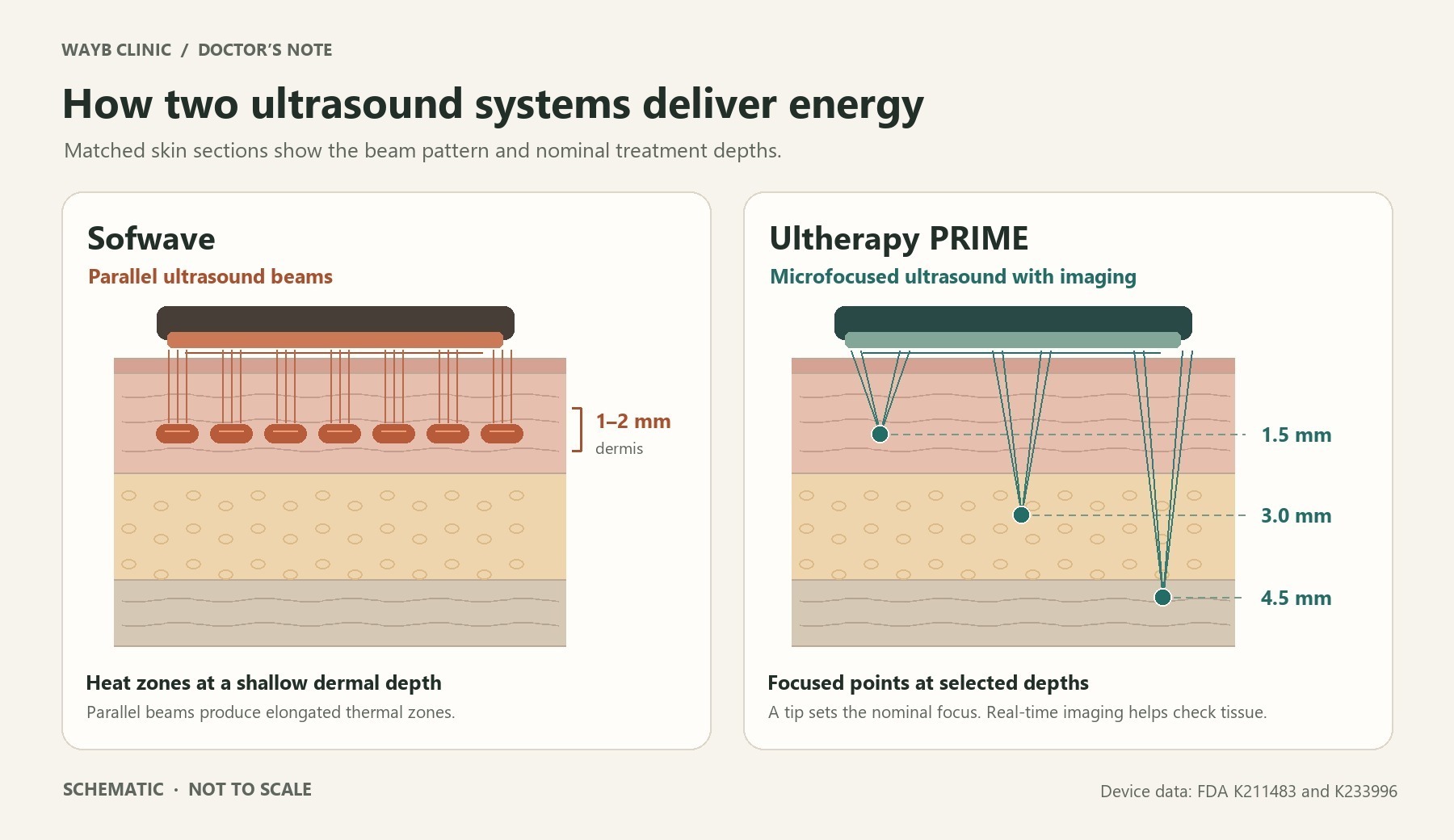
Sofwave uses parallel ultrasound beams to heat the dermis approximately 1–2 mm below the skin surface. Ultherapy PRIME uses real-time ultrasound imaging to check tissue and skin contact while delivering microfocused ultrasound. Its transducers focus at 1.5, 3.0 or 4.5 mm, depending on the area and tissue.
Sofwave creates zones of heat in the dermis by delivering parallel beams. Ultherapy PRIME forms focal points at selected depths after the clinician checks the tissue on the ultrasound image. Both devices may be described using a value of 1.5 mm, and the shape and spread of heating still depend on how the energy is delivered.
What the studies tell us about the face and neck
A randomized study treated the inside of each participant’s upper arms, with Sofwave on one side and imaging-guided microfocused ultrasound on the other. Fourteen women completed the study. Both sides showed improvements in skin laxity and fine crepiness, and pain scores did not differ significantly. The treatment area, small sample and 90-day follow-up limit what this study tells us about Ultherapy PRIME on the face or neck. Loyal et al.
A separate Sofwave study treated 42 Asian adults once on the face and neck. Investigators rated laxity under the chin and on the neck as improved in 35 of 42 at three months and in 27 of 39 who returned at nine months. Sofwave Medical funded the study, which had no untreated comparison group. Chung et al.
In an early Ultherapy PRIME study, 30 Asian adults were treated across three Singapore clinics. At 90 days, 26 people improved by at least one point on the neck scale and 21 did so on the jawline scale. Merz Aesthetics supported the early experience program. The two face and neck studies used different definitions of improvement, so the percentages do not provide a direct comparison. Lim et al.
At a consultation, point out the area you most want to change. Fine lines visible at rest, a softer jawline and loose skin under the chin can call for different approaches. Tell your clinician where and when you had fillers, a thread lift or an energy-based treatment.
Original studies and technical documents
- Loyal et al., Dermatologic Surgery (2026)
- Chung et al., Lasers in Surgery and Medicine (2026)
- Ultherapy PRIME, Plastic and Reconstructive Surgery – Global Open (2025)
- SofWave System, FDA K211483
- Ulthera System PRIME, FDA K233996
- Amiri et al. · Systematic review of MFU-V (2025)