

Clinical Notes
Have Re2O’s Effects Been Confirmed in a Study? A Doctor Reviews Its Mechanism, Injection Technique, and Side Effects
A guide to Re2O’s hADM component and a review of a 20-week study of 20 participants, including the study’s limitations.
An introduction to Re2O’s hADM component and how it works, with a review of a clinical study that followed 20 participants for 20 weeks, covering changes in skin hydration and elasticity, assessment time points, and the study’s limitations.
If you have been looking into skin boosters lately, you have probably heard the name “Re2O” quite often.
“I heard it contains material derived from human skin. Is that okay?”
“How is it different from Rejuran or hydrating skin injections?”
“Have its effects really been confirmed in a study?”
To answer these questions, I need to look at actual research findings rather than advertising claims.
Currently, there is one clinical paper directly examining Re2O, published in 2026.
Today, I will read through this paper from beginning to end and explain what has been established and what remains unknown.
This article is based on “A Literature Review of the Mechanism and Injection Technique of Re2O (hADM),” presented by me, Jisu Lee, Medical Director of WayB Clinic, at an online seminar hosted by the ARAM Practical Aesthetic Medicine Study Group on November 11, 2026.

Online seminar announcement from the ARAM Practical Aesthetic Medicine Study Group (November 11, 2026; presenter: Dr. Jisu Lee, Medical Director of WayB Clinic)
Summary at a Glance
- Re2O is a skin booster made by removing cells from donated human dermis and processing the remaining collagen structure into fine particles.
- Rather than stimulating cells to produce collagen, it directly replenishes the collagen framework in which cells can settle.
- In a 2026 clinical trial at Yonsei University’s Severance Hospital, the two halves of the faces of 20 adults were compared over 20 weeks.
- At week 20, the side treated with Re2O plus a hyaluronic acid skin booster showed about an 11% increase in volume, a 32% reduction in pore area, and a 21% reduction in under-eye wrinkles. The side treated with the skin booster alone showed changes of about 1%, 17%, and 11%, respectively.
- In animal experiments, new collagen formed mainly at the edges of the particles. The study did not establish whether changing the distribution of the injections affects outcomes in people.
- However, this is a single study involving 20 participants over 20 weeks, so long-term effects and rare side effects have not yet been established.
1. What Is Re2O?
Re2O is a skin booster that makes the structural framework of human dermis injectable.
The medical term is hADM (human acellular dermal matrix), also referred to as acellular allogeneic dermis.
There are three steps in its production.
Donated human dermis is prepared, cells that could trigger an immune response are removed, and the remaining collagen and elastin structure is finely ground into particles.
According to the paper, approximately 80% of the material is collagen and approximately 3% is elastin.
Acellular dermis is not, in fact, a new material.
It has long been used in sheet form for breast reconstruction and burn treatment.
Re2O adapts this material for use as a skin booster injected superficially into the skin.
2. How Does Re2O Work?
In one sentence, rather than pushing cells to produce collagen, it replenishes the collagen framework itself—the environment in which the cells live.
Conventional collagen-stimulating injections introduce synthetic particles, prompting the skin to respond by producing collagen.
Re2O takes a different approach.
The researchers explain that it directly introduces a structure corresponding to the skin’s framework, allowing the skin’s own cells to move into it and settle there.
In the paper’s animal experiments, fibroblasts gathered at the edges of the particles one week after injection, and an increase in new collagen was observed in the same areas.
Cell experiments showed increased collagen and elastin production and reduced levels of inflammation-related substances.
There is an important point to understand here.
This mechanism was demonstrated in cells, animals, and excised skin tissue.
It was not directly confirmed through skin biopsies that the same process occurs within human skin after injection.
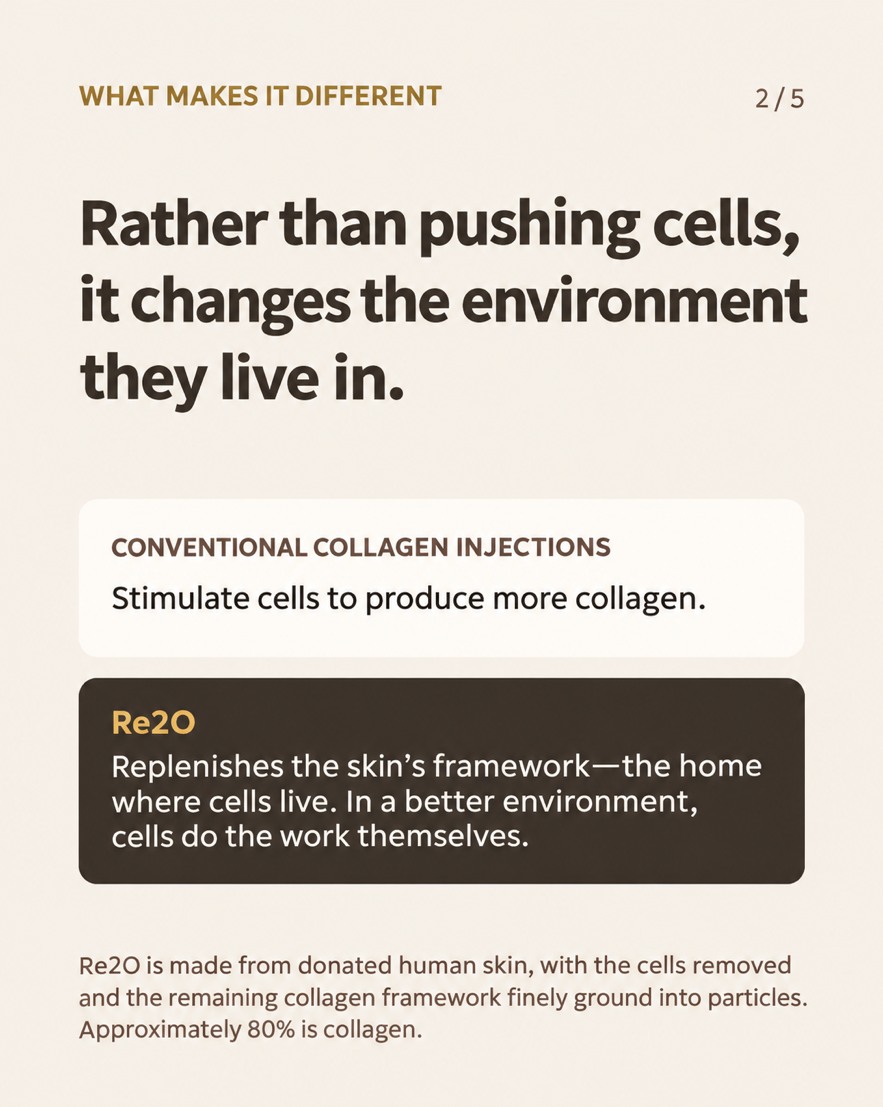
Presentation summary slide: Differences between the mechanisms of Re2O and conventional collagen injections
3. How Is Re2O Injected?
The key point is that it should be distributed as evenly as possible across multiple sites, rather than injected in a large amount at one site.
The reason lies in the animal experiment findings.
One week after injection, the proportion of new collagen was approximately 6% at the center of the particles and approximately 19% at the edges in contact with the surrounding skin.
These are approximate values read from a graph in the paper, but it is clear that new collagen formed mainly at the interface between the Re2O particles and the surrounding skin.
What, then, happens if the particles are clustered in one place?
One interpretation is that the surface area in contact with the surrounding skin decreases, leaving less space for new collagen to form.
This is my interpretation of the experimental findings, not a conclusion stated in the paper.
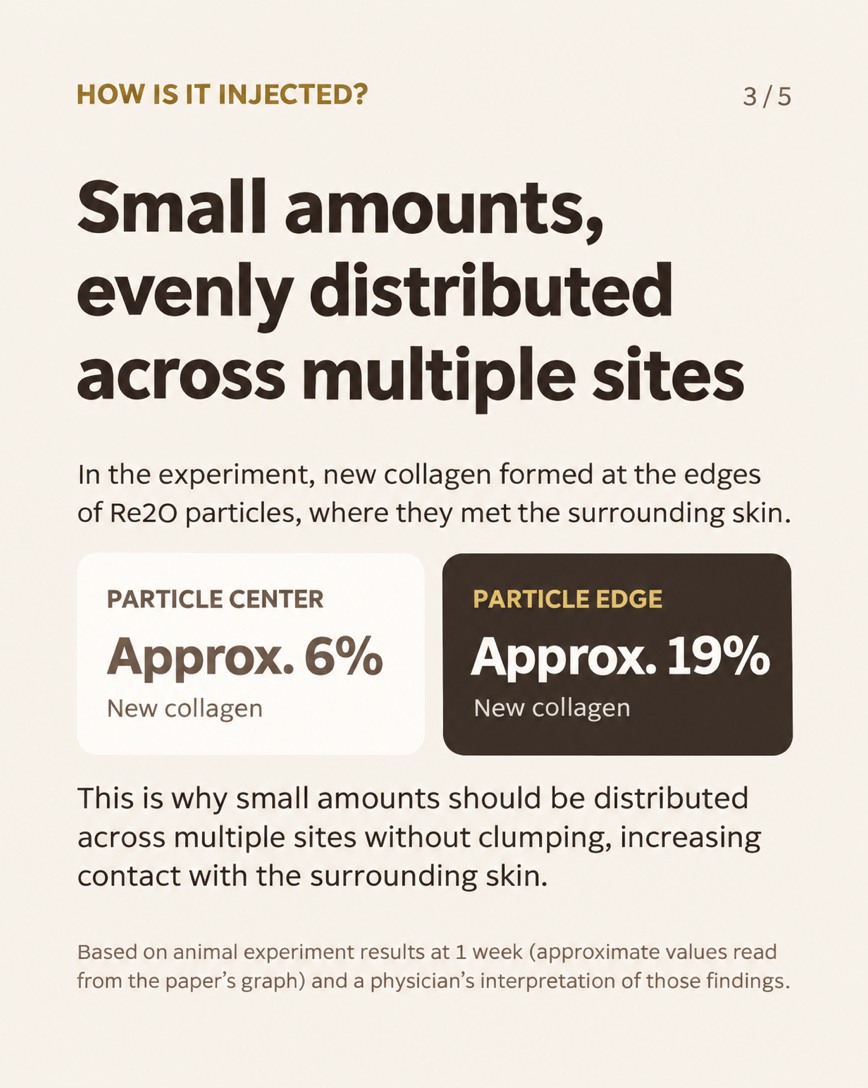
Presentation summary slide: Comparison of the proportion of new collagen at the center and edges of Re2O particles
In the clinical trial, 150 mg of Re2O was mixed with 1.5 mL of a hyaluronic acid skin booster, normal saline, and lidocaine to make a total of 4 mL.
Then, 1.5 mL was evenly injected into the mid-dermis on one side of the face using an automated injection device.
The paper does not separately specify the number of treatment sessions or the intervals between them.
4. How Was the Study Conducted?
The clinical trial was conducted by the Department of Dermatology at Yonsei University’s Severance Hospital.
Twenty adults aged 30-65 with rough cheek skin participated, and their mean age was 54.7 years.
The key feature of this study was its comparison of the two halves of each participant’s face.
One side was injected with a mixture of Re2O and a hyaluronic acid skin booster, while the other received the hyaluronic acid skin booster alone.
Neither the patients nor the clinicians evaluating the results knew which treatment had been administered to which side.
Comparing the left and right sides of the same person reduces the influence of individual differences such as age and skin type.
Skin condition was then measured for 20 weeks (approximately five months) using devices including ultrasound and a 3D camera.
5. What Were the Results After 20 Weeks?
The side treated with Re2O in combination showed greater improvement in most measures.
- Measure — Skin density
- Re2O + Hyaluronic Acid — Approx. 15% increase
- Hyaluronic Acid Alone — Approx. 9% increase
- Measure — Volume
- Re2O + Hyaluronic Acid — Approx. 11% increase
- Hyaluronic Acid Alone — Approx. 1% increase
- Measure — Pore area
- Re2O + Hyaluronic Acid — Approx. 32% decrease
- Hyaluronic Acid Alone — Approx. 17% decrease
- Measure — Under-eye wrinkles
- Re2O + Hyaluronic Acid — Approx. 21% decrease
- Hyaluronic Acid Alone — Approx. 11% decrease
- Measure — Hydration
- Re2O + Hyaluronic Acid — Approx. 21% increase
- Hyaluronic Acid Alone — Approx. 14% increase
- Measure — Transepidermal water loss
- Re2O + Hyaluronic Acid — Approx. 11% decrease
- Hyaluronic Acid Alone — Approx. 3% decrease
Percentage changes at week 20, calculated from the mean values for 20 participants in Table 2 of the paper.
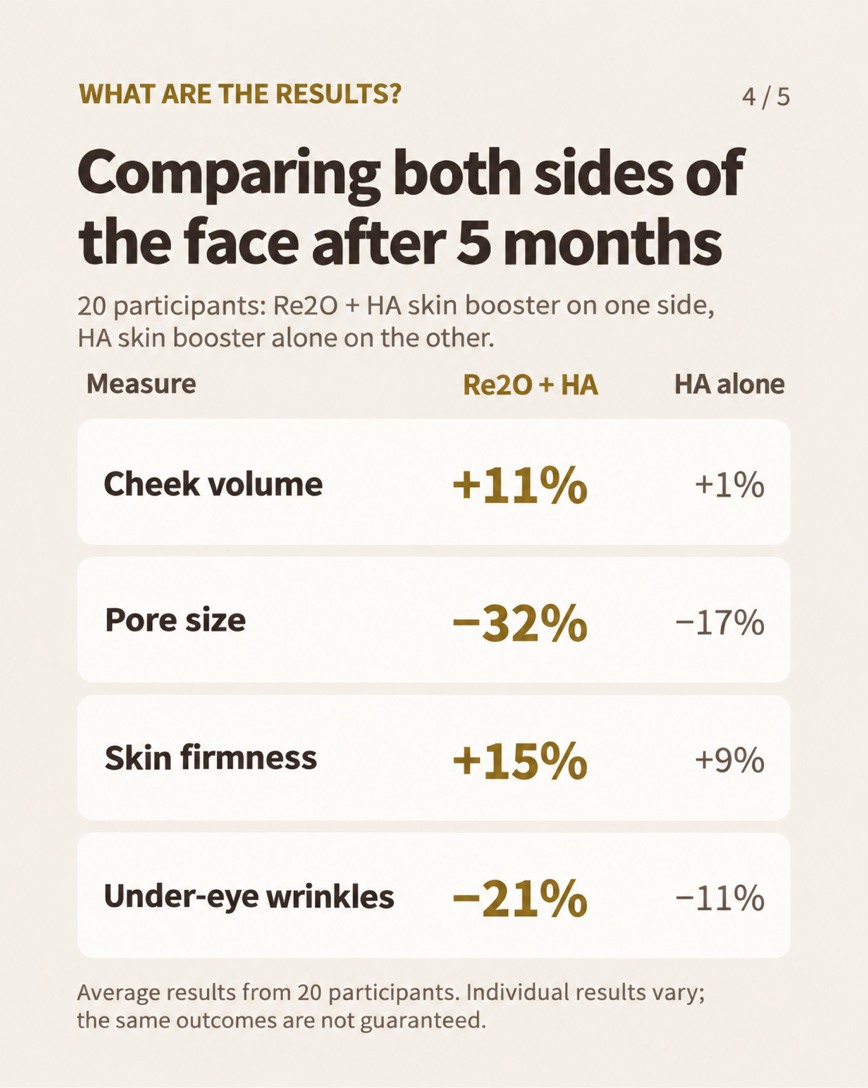
Presentation summary slide: Comparison of the Re2O clinical trial results at week 20
The clearest difference was in volume.
The side treated with hyaluronic acid alone showed almost no change over 20 weeks, whereas the side treated with Re2O in combination increased by approximately 17% at week 16 before declining to approximately 11% at week 20.
Differences between the two sides emerged from week 12 for pores and from week 8 for under-eye wrinkles and hydration.
In other words, the differences appeared over two to three months rather than immediately after injection.
Did every measure show favorable results, then?
Not quite.
Although the difference in nasolabial fold depth was statistically significant, the actual difference was very small, at approximately 0.007 mm.
At week 20, the measured elasticity values were almost the same on both sides.
Pigmented area already differed between the two sides before treatment, making it difficult to attribute the findings definitively to Re2O.
Regarding safety, the study reported no serious adverse events over 20 weeks, and transient redness and mild swelling resolved without treatment.
6. What This Paper Alone Cannot Tell Us
After reading this far, you might think, “So its effectiveness has been proven?”
However, when reading a paper, I also need to consider its limitations.
① This Was a Study of 20 People Over 20 Weeks
There were 20 participants, and the observation period was approximately five months.
This study cannot tell us whether the effects persist after one year or whether rare or delayed side effects occur.
② These Are Not the Effects of Re2O Alone
Re2O was injected in combination with a hyaluronic acid skin booster.
It is therefore difficult to isolate the effects of Re2O on its own.
The researchers explicitly acknowledged this limitation.
③ The Study Did Not Compare Re2O with Other Skin Boosters
The only comparator was a hyaluronic acid skin booster.
There are not yet any studies directly comparing it with Rejuran or collagen-stimulating injections.
④ Only One Injection Method Was Evaluated
In the paper, a dermatologist injected the material into the mid-dermis using an automated injection device.
This study cannot tell us the effectiveness or safety of other injection methods.
⑤ The Relationship Between the Researchers and the Manufacturer
The paper states that the corresponding author served as a development adviser for the product and that the manufacturer supplied the study products.
This does not mean the findings are incorrect, but it is a reason why further research by independent investigators is needed.
There is one more point to consider.
In July 2026, a case report describing a vascular complication in the forehead following Re2O injection was published in a journal.
In this report, pain and redness appeared two days after injection. A single case report cannot establish how often this occurs.
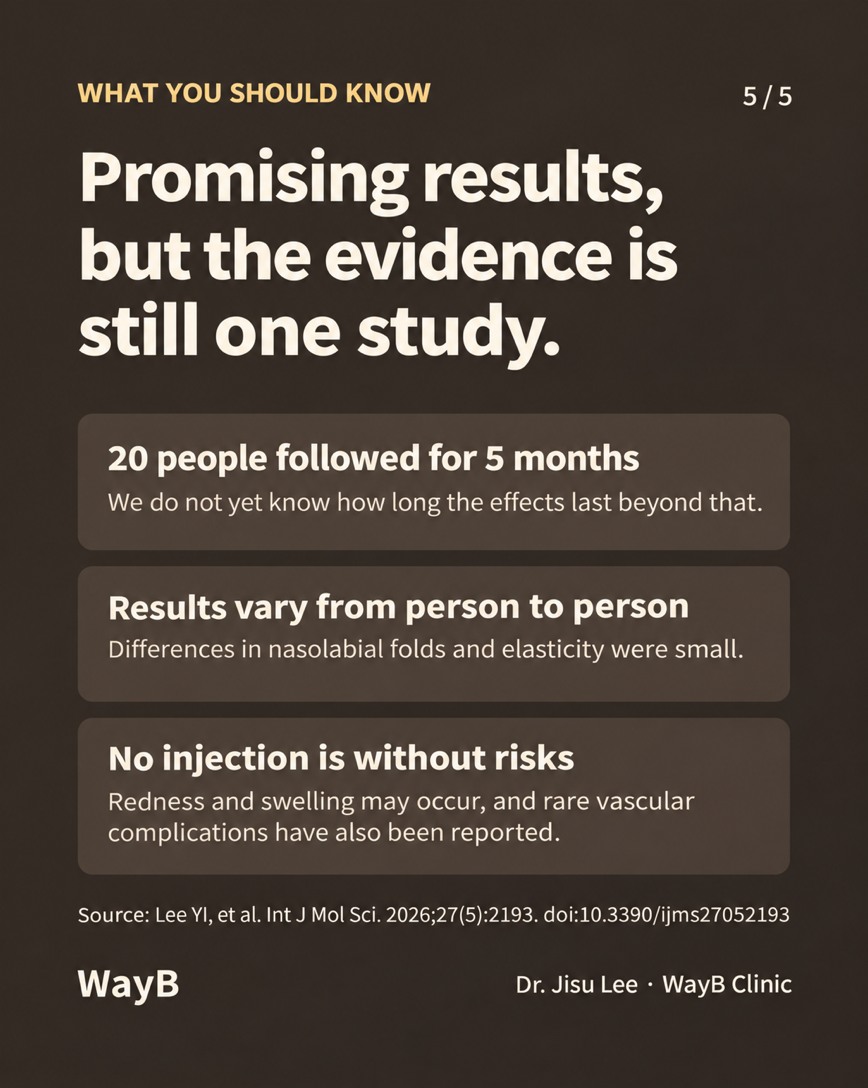
Presentation summary slide: Limitations of the Re2O study and points to keep in mind
7. Frequently Asked Questions About Re2O
Q. What Is Re2O Made Of?
It consists of fine particles of the extracellular matrix remaining after cells are removed from donated human dermis. According to the paper, approximately 80% is collagen.
Q. Have Re2O’s Effects Been Confirmed in a Study?
There is one randomized clinical trial published in 2026. In 20 adults, the side treated with Re2O plus a hyaluronic acid skin booster showed greater improvements in measures including skin density, volume, pore area, and hydration over 20 weeks. The study did not test Re2O on its own.
Q. How Long Do Re2O’s Effects Last?
The period confirmed in the paper extends to 20 weeks (approximately five months). No studies have yet established how long the effects last beyond that point.
Q. How Many Re2O Treatments Are Needed?
No studies have yet compared the optimal number of sessions or treatment intervals. At WayB Clinic, I consider three to four sessions at approximately one-month intervals as a starting plan and adjust it according to the skin’s response.
Q. How Does Re2O Differ from a Hyaluronic Acid Skin Booster?
Hyaluronic acid skin boosters primarily provide hydration. Re2O differs in that it replenishes the collagen structure itself, and the study found the clearest differences in volume and skin density.
Q. What Are the Side Effects of Re2O?
Transient redness and mild swelling were reported in the clinical trial. A separate case report described a vascular complication, and it is also important to know that Re2O cannot be dissolved with hyaluronidase because it is not hyaluronic acid.
Q. How Is Re2O Injected?
In the clinical trial, it was mixed with a hyaluronic acid skin booster and injected into the mid-dermis using an automated injection device. Because new collagen formed mainly at the edges of the particles in animal experiments, even distribution is important to prevent the material from clustering in one place.
Q. When Do Re2O’s Effects Begin to Appear?
In the clinical trial, differences from hyaluronic acid alone emerged from week 8 for under-eye wrinkles and hydration and from week 12 for pores. The increase in volume was greatest at week 16.
Q. How Does Re2O Differ from Rejuran?
Rejuran contains polynucleotides (PN), while Re2O consists of a collagen structure derived from human dermis. Their ingredients and mechanisms differ, and there are not yet any clinical studies directly comparing the effects of the two products.
Q. Is Re2O Safe Even Though It Is Derived from Human Skin?
According to the manufacturer’s materials, it undergoes donor eligibility assessment, infectious disease screening, tissue processing and sterilization, and traceability procedures. However, risks such as infection, inflammation, hypersensitivity reactions, and nodules remain, so a consultation is necessary before treatment.
Q. Which Should I Have First, Rejuran or Re2O?
Rejuran may be considered for dryness and fine lines, while Re2O may be considered when the skin feels thinner and less firm. The decision is based on skin thickness and previous treatment history.
Q. How Long Is the Recovery Period After Re2O Treatment?
Redness, swelling, bruising, and small raised injection bumps may occur, and swelling can last approximately seven days. Gentle cleansing is possible approximately three to four hours after treatment, and makeup can be applied from the following day.
8. How Is Re2O Administered at WayB Clinic?
At WayB Clinic, I introduce Re2O as a skin booster to consider when the skin feels thinner and less firm.
It May Be Considered in the Following Cases
- When the skin feels thinner and less firm
- When fine lines and rough skin texture are concerns
- When pores are noticeable and the skin surface is uneven
By contrast, other treatments may be more suitable for deep scars, pronounced hollowness, sagging, melasma, or dark spots.
How the Treatment Is Performed
Treatment is performed after topical anesthesia, with the treatment area and injection method adjusted according to skin thickness and the areas of concern.
I adjust anesthesia and injection speed to reduce discomfort during treatment.
As explained earlier, my principle is to distribute the material evenly across multiple sites so that it does not cluster in one place.
How Many Sessions Are Needed, and at What Intervals?
I consider three to four sessions at approximately one-month intervals as a starting plan and adjust it according to the skin’s response.
However, the effects and duration of repeated treatments have not been established through research, and results may vary between individuals.
Recovery and Aftercare
Redness, swelling, bruising, tenderness, and small raised injection bumps may occur.
Swelling can last approximately seven days, so it is advisable to allow about a week before an important event.
Gentle cleansing is possible approximately three to four hours after treatment, and makeup can be applied from the following day.
Avoid saunas and strenuous exercise for approximately one week, and do not press or rub the treated area firmly.
Contact the clinic if swelling has not started to improve after seven days or if you notice a firm lump. Get medical care right away if pain worsens or the skin turns pale or bluish. If you have sudden blurred vision or loss of vision, call 119 in Korea immediately and get emergency care.
Can It Be Combined with Other Treatments?
Overlapping irritation in the same area may prolong recovery, so I generally allow an interval of two to four weeks.
The treatment sequence is determined during consultation based on skin condition and previous treatment history.
WayB Clinic Re2O treatment guide: https://wayb.clinic/treatments/Re2O/
9. Who Wrote This Article, and What Is It Based On?
I am Jisu Lee, Medical Director of WayB Clinic, and I wrote this article personally.
On November 11, 2026, I presented “A Literature Review of the Mechanism and Injection Technique of Re2O (hADM)” at an online seminar hosted by the ARAM Practical Aesthetic Medicine Study Group.
This article reorganizes that presentation into a format that is easy for general readers to understand.
Topics Covered in the Seminar
- Study design: The structure of the randomized, split-face, double-blinded clinical trial
- Mechanism: Findings related to collagen production and inflammation from cell, animal, and skin tissue experiments
- Clinical results: Changes in skin density, volume, pores, wrinkles, hydration, and skin barrier measures over 20 weeks
- Injection technique: The dilution ratio and injection depth used in the paper, and why even distribution matters
- Limitations and safety: Study size, the relationship between the researchers and the manufacturer, and the vascular complication case report
Standards Used in Writing This Article
- I read the original paper from beginning to end and checked the figures directly against its tables and graphs.
- I distinguished between the paper’s findings and my interpretation.
- Where information has not yet been established, I stated that it remains unconfirmed.
About the Author
I personally provide injectable treatments, including fillers and skin boosters, at WayB Clinic in Gangnam, Seoul.
I serve as a key opinion leader (KOL) for STYLAGE fillers and follow the principle of reviewing the published evidence before introducing a new treatment into clinical practice.
WayB Clinic has on-site staff available for consultations in English, Chinese, and Japanese.
Conclusion: Promising Findings, but the Evidence Still Consists of One Study
Re2O is a skin booster with a clear mechanism that showed meaningful results in its first clinical study.
However, the current evidence consists of a single study that followed 20 people for 20 weeks.
When choosing a new treatment, what matters is not the trend but understanding what has been established so far and what remains unknown.
At WayB Clinic, I explain treatments by distinguishing between what research has established and what has not yet been confirmed.
Reference study: Lee YI, Chau NH, Nguyen NH, Ham S, Baek Y, Kim J, Lee JH. Injectable Particulated Human Acellular Dermal Matrix Booster for Skin Restoration: An Integrated Randomized, Split-Face, Double-Blinded Clinical Trial and Preclinical Study. Int J Mol Sci. 2026;27(5):2193. https://doi.org/10.3390/ijms27052193
Reference case report: Sung, et al. Vascular Complication Following Injection of Particulated Human Acellular Dermal Matrix: A Case Report. J Cosmet Dermatol. 2026;25(7):e71049. https://onlinelibrary.wiley.com/doi/10.1111/jocd.71049
Written by Dr. Jisu Lee, Medical Director of WayB Clinic · Based on the presentation at the ARAM Practical Aesthetic Medicine Study Group online seminar (November 11, 2026) · Last updated November 12, 2026
※ This article provides general medical information. Bruising, swelling, redness, nodules, and inflammation may occur after skin booster treatment, and serious side effects, including vascular complications, have been reported. Treatment suitability and results vary between individuals, so a thorough consultation with a medical professional is necessary.